



Car Design Sketching | Learn Pro Techniques Here!
Updated- June, 2026
There are so many skills that have to be mastered when learning how to draw cars and if you are ever going to make it as a professional car designer. In our last 2 How To Draw Cars videos, the goal was to get to the essence of what makes car design sketching look professional vs. car design sketches that look amateurish.
The look of your car design sketching is the proof that you are getting better. The goal should always be to move your skills forward. If you want to apply to a top design school or go for a scholarship, the more advanced your skills are, the better your chances are of success. This success will come the more accurately and passionately you can showcase your design ideas through your finished drawings and concept sketches. It’s that simple.
Our last 2 videos have been receiving a very positive response. I hope that they are helping everyone who has watched them. A couple of new students have signed up for the How to Draw Cars program recently. With this, I noticed a particular trend.
Watch the Video and Discover the Secrets to Better Car Design Sketches
What’s the Best Way Improve Your Car Design Sketching?
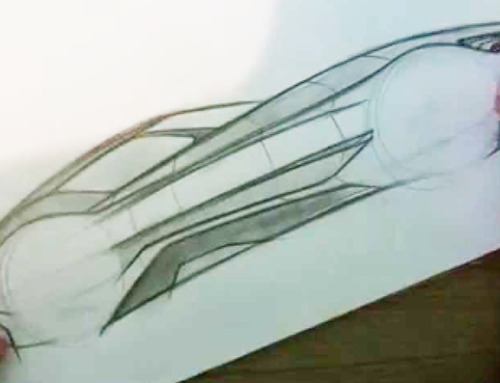
When some of the students were sketching speed forms and trying to learn to draw from their shoulder, the weight of their lines, of the actual marks they were making on the paper were all the same. The thickness of the lines were not varied which is usually the result of drawing from your shoulder.
Some of this could be the result of using fine art pencils vs. a soft leaded colored pencil as prescribed and shown in the videos. The soft lead of the colored pencils like Prismacolor Premiere actually teach you to go easy when you first start sketching. If you don’t, the lead gets very dull very fast and your initial “thinking” lines will be much too dark as the drawing progresses.
This is why these pencils are recommended. I do understand that they might not be available in every location around the world. Use what you can get your hands on. The lead should be very soft, almost crayon like, with a rich waxy texture. Some colored pencils have a very hard lead and do not work well for learning car design sketching in the manner I am trying to suggest.
Michael’s Pro Insight: Drawing like a professional car designer
“It takes years to master the skills of a professional car designer, but it all starts with understanding how to use line weight. As a beginner, line quality and line weight are actually more critical than ideas. Concepts are great to have, but if you cannot express them due to poor sketch execution, frustration grows and many aspiring designers quit. The very first thing I teach when a student starts working with me is how to use line weight like a professional. Yes, it takes time and focused practice but once you begin to make your lines flow across the page, a whole new world opens up. Skill development and design ideas come much more rapidly, and the results do follow. Looking to improve more quickly? Get in touch.
The Importance of Line Weight
I went back and looked at the work that was submitted by the new students with their applications to our program. In their sketches, all the lines were the same weight. The new sketches they were sending me to show me their progress also had a single or near single line weight. Hummm.
As someone who struggled with all of this myself, I know that there is not a single thing in the pursuit of getting better at sketching cars that you can master in one day or even a week. There is no magic download program like in movie The Matrix. Where you can learn a complex skill in a matter of seconds. All of the techniques unitized by car designers take hundreds of hours to get better at and thousands of hours to master.
As I have said before, drawing cars is hard. Drawing cars of your own design is infinitely harder still. Once you realize this you can get on with the business of improving your skills. You know and accept that you need to put in the hours, do the mileage, make a commitment and let your passion drive you. This is not going to happen in an afternoon.
Varying Your Line Weight
Reviewing all the student work, I thought long and hard about the idea of line weight. What might be holding someone back from changing how they sketch? Could you teach someone to make sure they started out with light lines? Then gradually build up key areas of their design drawing as you went along?
The goal of varying your line weight is to emphasize certain parts of your drawing, to call attention to one area over another. This worked for the masters during the Renaissance and it will work for you today. It also allows for the structure of your drawing, all the lightweight “thinking” lines put in early in the process, to remain visible. This is a game-changer for car design sketching.
This adds texture, depth and interest to your car design sketching. It also shows you’re thinking. And that you understand that what you are tying to represent is a three dimensional object in space.
Curious About How to Take Your Drawing Skills to the Next Level?
Do you love to draw? Do you have a passion for car design? Are you looking to improve your car design sketching? Are you wondering how to put together a portfolio so you can apply to a top school? Check out this quick video that follows one of our student’s path to successful admission to a top automotive design program. For more info on the program that Abhi used to achieve his success, check our Automotive Design Course.
Should Every Line Be the Same Weight?
Creating these types of layers in car design sketching, with nuance and depth in the line work, can only happen once you are aware that you have options. If no one ever holds up a sign that says, “Not every line has to have the same weight or thickness”, you might never realize it. So I’m holding up that sign.
Not every line in your car design sketching has to have, nor should it have, the same weight or thickness. In fact, if you want to make sure your sketches are rich, layered, textured and have the maximum visual interest, I would highly suggest you never do another car sketch with uniform line weight again.
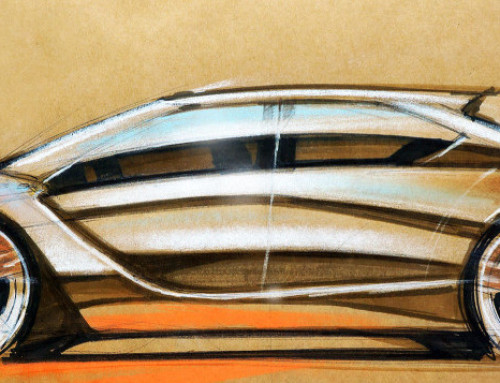
Of course there are variations on this idea. A finished rendering will have many of the structure lines covered up with medium or erased in the pursuit of a presentation quality piece. But even a finished presentation drawing can include varying line weights to add interest, depth and richness. All of these choices, what to leave in, what to take out, are based on your own individual aesthetic sensibilities which should develop to a professional level over time. And they will.
Express Your Passion Through Your Car Design Sketching
This is one of the reasons I wanted to start this tutoring service. Anyone interested in car design sketching is creating drawings that are “x” number of steps away from looking professional. You might be one session, one lesson, one suggestion away from admission to a top design college, masters program or full scholarship.
On the other side of the spectrum, your drawings may have more in common with the cars from the animated Pixar movie “Cars”. You want your car design drawings to look like they could have come out of a design studios of an auto manufacturer.
While you may have the passion, your drawing technique needs work. The perspective is off. The surfaces are awkward. And maybe your line quality shows no variation whatsoever. The question then becomes, how good do you want to be? How quickly do you want to get there?
Your first step might be to pay some serious attention to the quality of your line work. Master drawing from your shoulder. Put in your structure lines lightly and build your drawings over the top of them.
This will add depth and richness and show you’re thinking. You want your car design drawings to express your passion and your understanding of surface to the best of your ability. Not maximizing your line quality is trying to do this with your drawing hand tied behind your back. Focus on line quality and line weight.
If you have any questions regarding the information contained in this article, please leave them in the comments section below and we will get them answered.

About the Author – Michael Santoro
Michael Santoro is an award winning American automotive, transportation and product designer. He spent 6 years as an exterior designer for Chrysler where he created the the 1995 Car of the Year, Chrysler Cirrus and it’s sibling, the Dodge Stratus. Before leaving Chrysler, Mr. Santoro penned the exterior for the 1996 Jeep Wrangler returning the iconic vehicle to it’s roots. As part of his Jeep design, he created the first automotive “Easter Egg”. A practice now widely used throughout the industry to connect with owners and brand enthusiasts. In 1998 he created the Apple-specific case market with the launch of MacCase, a company he still runs today. He created the livery designs for a pair of Audi TCR RS3 race cars which went on to win the National Championship. Mr. Santoro has taught transportation design at Pratt Institute and guest lectured at College for Creative Studies (CCS) and Art Center College of Design. He recently expanded his tutoring efforts to 10 creative disciplines through Art College Prep.
9 Comments
Leave A Comment
Related Posts



What are the different lines drawn in car sketching???
There is no master list of specific lines. It’s not math that makes a great car sketch, it’s poetry. The skills to create a great drawing come from hours and hours of practice. You need to learn to draw from your shoulder. Once this is achieved, the ability to master the different line weights that make up a great car design sketch will be in place. If you have not done so, I would signup for this – https://www.udemy.com/introduction-to-automotive-design/
It will walk you through the basic techniques you need to get started drawing cars like a designer.
V-
When car design sketching, there are basic structure line that your underpin your drawing. These lines are are done lightly and act as the skeleton or framework for everyone that you build on top of it. Darker or heavier lines tell the story of your idea or your concept. The line weight for these line can vary greatly. This is where your skill as an artist kicks in. The combination of light constrauciton lines and heavier lines that express your idea are the different lines that make up car design sketching.
how is it possible to vary your line weight? i know things like dor lines and usually really slick but where are other areas where your lines need to be either really thick or very light? thank you
You vary the pressure on the pencil. Thin lines are used for underlays and building structure. Thicker lines are used to define your form or add emotion.
thank you very much sir im slowly getting better at designs, i think it might be a good idea to get the videos on Udemy, though some of the aspects are still confusing as my lines aren’t always proportional to the drawing.
Here are the links –
https://www.udemy.com/course/introduction-to-automotive-design/?referralCode=17C40D3D6D40C2E8CBCB
https://www.udemy.com/course/automotive-design-level-2/?referralCode=7487EEFD9C778A22A1BE
What you need to remember is what you are trying to get good at is something that is extremely hard to do. It’s not going to happen in a few hours, days, weeks or months. A commitment of years is needed. This is why you have to have a passion for it. The passion sustains you through all the hours, days and weeks where you’re not seeing any improvement. Of course, it helps if you’re working with me one-on-one and I can point out what you need to do to improve each week. You will see a big improvement between where you are in week 1 of the class and where you are in week 10 or 12. Keep working at it and don’t forget to enjoy it and have fun.
thanks alot for the advice mr michael! my lines are become smoother with the drawing on the shoulder technique but its still quite hard to pull off.